
Tragedy in the Skies: Passenger Jet Carrying Over 244 Crashes Amid Fire and Chaos
Reports are emerging of a catastrophic plane crash involving a commercial aircraft with more than 244 passengers on board. While officials have yet to confirm key details—including the airline, flight origin, or destination—the magnitude of the disaster is already becoming tragically clear.
Eyewitnesses described horrifying scenes at the crash site: towering flames, dense smoke, and scattered wreckage engulfed in chaos. First responders launched a large-scale emergency operation, scrambling to control the blaze and search for any survivors.
The urgency on the ground is palpable, with medical teams, firefighters, and law enforcement coordinating under extreme pressure.
At this stage, the cause of the crash remains unknown. Aviation analysts are reviewing multiple scenarios—ranging from mechanical failure or pilot error to the possibility of extreme weather conditions. Investigators are expected to begin examining black box data and flight communication logs as soon as the wreckage is secured.
Hospitals in nearby regions have been placed on high alert in preparation for potential casualties. Meanwhile, families of passengers are being directed to emergency centers, where they wait anxiously for news of their loved ones.
In the absence of concrete answers, public anxiety is growing. Government officials have pledged a full and transparent investigation, while aviation authorities and global leaders begin responding to what could be one of the deadliest air disasters in recent memory.
Across social media platforms, messages of shock, sympathy, and solidarity are pouring in. The sheer scale of the tragedy has struck a global nerve, leaving many mourning and others demanding clarity on how such a disaster could occur.
A Global Moment of Grief and Uncertainty
With so many lives lost or unaccounted for, the world watches and waits. Investigators face the immense task of uncovering the sequence of events that led to this crash. Until then, questions hang heavy in the air—questions that demand answers, not speculation.
This devastating event marks one of the darkest moments in recent aviation history. As the search for truth continues, the global community remains united in grief, and in the hope that survivors may yet emerge from the wreckage.
MOMENT GOP Congress Man Eli Crane TOTALLY DESTROY Democrat Governor Tim Walz Using His Own Words pssss
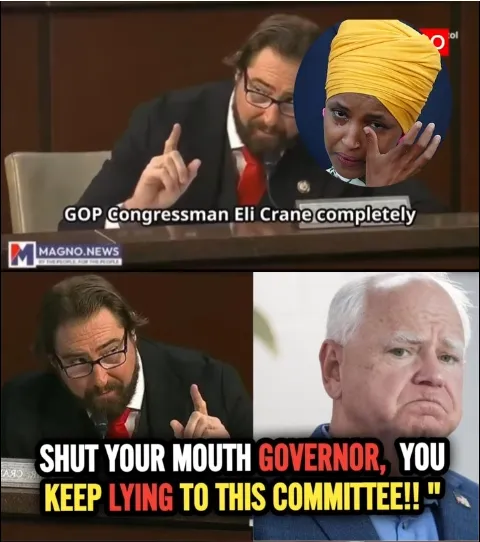
MOMENT GOP Congress Man Eli Crane TOTALLY DESTROY Democrat Governor Tim Walz Using His Own Words

The Rhetoric vs. Reality: Governor Walz’s Congressional Roasting
The recent congressional hearing was a masterclass in political confrontation, featuring GOP Congressman
Eli Crane absolutely torching Democrat Governor Tim Walz
on a variety of issues, ranging from immigration policy to incendiary rhetoric. Crane didn’t just ask questions; he delivered an execution via the Governor’s own words, showcasing a perceived disconnect between Walz’s statements and the hard realities of his state’s policies.
The Immigration Inconsistencies: “Why Are You Lying?”
The exchange began with a direct challenge to the Governor’s opening statement, where Walz claimed that “nothing Minnesota has done stands in the way of federal government managing its border security policy.” Crane immediately called him out, asking,
“Why are you lying to this committee?”
The core of Crane’s attack was the public stance of Minnesota’s Attorney General, Keith Ellison, the state’s top law enforcement official. Crane submitted an article stating that AG Ellison “will not enforce federal immigration laws,” even as the DOJ threatens prosecution for officials who resist. Walz’s defense—claiming state law requires officials to ask for immigration status of convicted felons—was swiftly dismissed by Crane as a misrepresentation, insisting that the AG’s public defiance stands as a clear contradiction to the Governor’s assurance of non-interference.
Crane then moved to the argument that Minnesota’s policies actively create a border magnet, citing a list of state benefits: free healthcare, food assistance, free college tuition, driver’s licenses, and cash assistance.
In Crane’s judgment, these policies are not “helping” border security but are rather creating an irresistible incentive, effectively making Minnesota a “sanctuary state” in practice, regardless of official designation.
The Toxic Messaging: ICE and the “Gustapo”
The scrutiny intensified as Crane addressed the Governor’s rhetoric, particularly Walz’s past characterization of ICE (Immigration and Customs Enforcement) agents.
Crane grilled Walz on his decision to call federal law enforcement agents
“modern-day Gustapo,” a deeply offensive historical parallel. Crane challenged the Governor directly: “You think that calling them Gustapo is helping?” Walz attempted to pivot to a defense of “due process” and “best practice in law enforcement,” but Crane hammered the point that such inflammatory language from a state executive actively hurts the federal government’s ability to carry out its mandated enforcement.
Further damaging the Governor’s credibility was an unverified quote where Walz allegedly told Anderson Cooper, regarding the border wall, “If it’s 25 ft, then I’ll invest in a 30-foot ladder factory.” Walz claimed not to remember the comment, which Crane seized upon as evidence of “so many outlandish things that you can’t even keep track of them.”
The Radical Agenda and Electoral Damage
Crane saved his most powerful and judgmental rebuke for the end, focusing on what he labeled Walz’s “radical left-wing agenda.” He dismissed Walz’s previous podcast boast that he scares MAGA voters “because they know I can fix a truck” and could “kick most of their asses,” countering that the fear stems purely from his policies.
Crane’s list of “radical” policies included:
Supporting tampons in boys’ bathrooms.
Advocating for disarming Americans of their Second Amendment rights.
Being pro-sanctuary city.
Claiming there is “no guarantee to free speech”
when it comes to misinformation and hate speech—a view Crane acidly suggested Walz may have picked up during one of his alleged trips to “communist China.”
Finally, Crane weaponized Walz’s political aspirations against him, referencing a quote where Walz allegedly said Kamala Harris picked him for Vice President to “code talk to white guys.” Crane closed the interrogation with a decisive blow, stating Walz
“lost by 22 points to white guys” and promising: “If you want to continue that rhetoric, go on, brother. Keep doing it. We’ll keep destroying you in election.“
The entire spectacle, as the transcript concludes, was a decisive, one-sided clash where Congressman Crane used facts, undeniable quotes, and logic to demonstrate, in his judgment, the severe consequences of Governor Walz’s radical ideology and inflammatory rhetoric.
Election Highlights: Robert F. Kennedy Jr. Suspends Campaign and Endorses Trump
Mr. Kennedy appeared onstage briefly with Mr. Trump at a rally in Arizona hours after Mr. Kennedy announced, in a news conference nearby, that he was pausing his troubled independent presidential bid.

Robert F. Kennedy Jr., left, and former President Donald J. Trump at a Trump campaign rally in Glendale, Ariz., on Friday.Credit…Evan Vucci/Associated Press

One of the most attention-grabbing days of Robert F. Kennedy Jr.’s independent presidential bid was also its last.
After toiling for months as an electoral afterthought, Mr. Kennedy suspended his long-shot campaign on Friday and endorsed former President Donald J. Trump in a speech in Phoenix carried live by television networks. Then, he traveled across town to speak in front of the largest rally audience since he began his third-party run last year: an audience of 17,000 at a Trump event at an arena in Glendale, Ariz.
As he shook hands with Mr. Trump amid bursts of fireworks, Mr. Kennedy was, briefly, the star of the show, a new attraction for the Trump campaign. But it was unclear what impact, if any, Mr. Kennedy’s endorsement of Mr. Trump would have on the 2024 race.
Framing his third-party bid as an outsider movement and a breath of fresh air for Americans fed up with partisan politics, Mr. Kennedy initially attracted significant support — more than 20 percent in some early polls — and was especially popular with Hispanic voters. Many voters had said they were frustrated with the lack of choice between two unpopular and familiar candidates: Mr. Trump and President Biden.
But Mr. Kennedy had been falling recently in polls, and plummeted further after Vice President Kamala Harris took the mantle of Democratic nominee from Mr. Biden, luring some wayward Democrats back home. Even those supporters who have remained steadfast to Mr. Kennedy are less likely than others to say they will vote in November, and polls have not provided a consistent answer as to whether Mr. Kennedy’s supporters would prefer Ms. Harris or Mr. Trump.
Still, Mr. Trump and his allies on Friday relished the fact that the former president had won the backing of a member of America’s most storied Democratic family, albeit one who has had many of his relatives denounce him and his endorsement of Mr. Trump. Of all the outlandish political news stories of the summer, mused Charlie Kirk, the founder of Turning Point USA, which helped organize the rally, “maybe most remarkable of all: A Kennedy has endorsed a Republican.”
Mr. Trump predicted that Mr. Kennedy was “going to have a huge influence on this campaign,” promising that “Bobby and I will fight together to defeat the corrupt political establishment.”
But it is hard to know whether he will make a dent in the larger problem Mr. Trump has newly faced: regaining the spotlight and the narrative after several weeks of momentum for Ms. Harris.
As the vice president has surged ahead in fund-raising and tightened the race, according to polls, Mr. Trump has bemoaned the ouster of Mr. Biden, whom his allies viewed as an easier opponent, held a series of rambling news conferences and offered a freewheeling rebuttal on Fox News to Ms. Harris’s acceptance speech on Thursday night.

Mr. Trump has traded barbs with Mr. Kennedy in the past, but they have similar grievances that they could easily weave together on the campaign trail. They both blame a shadowy, bureaucratic deep state for many of the nation’s ills, and they argue that technology companies and Democrats want to suppress free speech.
“We talked not about the things that separated us — because we don’t agree on everything — but on the values and the issues that bind us together,” Mr. Kennedy told the crowd in Glendale, recalling a previous conversation he had with Mr. Trump. “Don’t you want a president that’s going to make America healthy again?”
Mr. Trump’s campaign stop in Glendale was his final event in a five-day swing through battleground states, timed to coincide with the Democratic National Convention in Chicago in an attempt to avoid ceding the spotlight to Ms. Harris.
For decades, Arizona was a reliably conservative state, but Democrats have taken advantage of Republican infighting in recent years to capture statewide offices, including for governor and both U.S. Senate seats. Joseph R. Biden Jr., then a presidential candidate, turned Arizona blue in 2020, but the state appeared to be trending back toward Mr. Trump earlier this year, as voters expressed concern about Mr. Biden’s age and the direction of the country.
Ms. Harris, though, has revitalized the Democratic base and made the state competitive again. Recent polls suggest a deadlocked race, and the party showcased its deep bench of prominent Arizona supporters at its convention, with speeches by Senator Mark Kelly, former Representative Gabrielle Giffords and others.
Republicans offered a rebuttal of sorts at Mr. Trump’s rally on Friday, featuring a litany of big names of their own, including Representatives Paul Gosar, Eli Crane and Andy Biggs. Another speaker was Kari Lake, a prominent Trump ally who is running for Senate and who became a leading proponent of his false stolen-election claims.
The choice of venue was another retort to Democrats. Ms. Harris rallied at the same location, Desert Diamond Arena, several weeks ago, and her campaign said the crowd numbered 15,000 people. Turning Point said the crowd in the arena on Friday was 17,000. Mr. Trump has flinched at Ms. Harris’s crowd sizes and falsely claimed that she was using artificial intelligence to inflate them in photos.
In his speech, Mr. Trump again broke with advisers who have urged him to focus on policy rather than veering into personal attacks. In recent weeks, he has taken events billed as opportunities to discuss components of his platform and set off on wide-ranging tangents filled with insults of Democrats.

“You say, ‘Don’t get personal.’ I have to get personal,” Mr. Trump said on Friday, proceeding to launch insults against the Obamas, Ms. Harris, Mr. Biden and Representative Ruben Gallego of Arizona, now a U.S. Senate candidate, whom he called a “maniac” and a “loser.” In fact, the only non-Republican he praised was Mr. Kennedy, whom he had once called a “Democrat plant” and a “radical left liberal” — to which Mr. Kennedy had responded that Mr. Trump was a “frightened” man who sounded “unhinged.”
But when Mr. Trump shared the stage with his former rival, those spars went unmentioned.
In welcoming his endorsement on the rally stage, the Trump campaign is betting that Mr. Kennedy can bring his supporters with him. In a memo earlier on Friday, the Trump campaign’s lead pollster, Tony Fabrizio, described the end of Mr. Kennedy’s candidacy as a clear benefit to the Republican nominee.
“This is good news for President Trump and his campaign — plain and simple,” Mr. Fabrizio wrote, describing a majority of Mr. Kennedy’s voters as overwhelmingly breaking in Mr. Trump’s favor.
Just how significant those percentages will be remains to be seen. The polling that exists about where Mr. Kennedy’s voters might go is based on the hypothetical scenario of his leaving the race. The actual impact of his departure will not be clear for many days or weeks.
Onstage on Friday, Mr. Trump renewed, “in honor of Bobby,” an unfinished pledge from his first term to create a commission that would release the remaining sealed files related to the assassination of John F. Kennedy, Mr. Kennedy’s uncle. Less than 1 percent of the records remain sealed, according to the Central Intelligence Agency.
Mr. Trump, who has said he would pardon those who rioted at the Capitol on Jan. 6, 2021, suggested at the rally that his supporters needed to take the country back from Democrats. “We have to take our country away from these people that are going to destroy our country,” he told the audience.
Earlier in the day in Phoenix, at his speech announcing the suspension of his campaign, Mr. Kennedy said Mr. Trump had offered him a role in a second Trump administration, dealing with health care and food and drug policy. In Glendale, Mr. Trump said that, if elected to a second term, a panel of experts “working with Bobby” would investigate obesity rates and other chronic health issues in the United States.
Mr. Kennedy later said he was “choosing to believe” that “this time” Mr. Trump would honor the agreement. During the transition period before Mr. Trump took office in 2017, Mr. Kennedy said Mr. Trump had offered him a spot on a vaccine safety commission, only to have the president-elect’s team distance itself from such claims hours later.
Mr. Kennedy’s remarks on Friday sought to cement what he saw as a legacy: pitching his policies on food, health and the environment and railing against the Democratic Party, which he believed treated him unfairly.
Maggie Haberman and Chris Cameron contributed reporting.
Trump has handed the podium over to Kennedy, who acknowledged their ideological differences but said their values overlap in “having safe food and ending the chronic disease epidemic.”

In Las Vegas, Trump called Harris a ‘copycat’ over a ‘no tax on tips’ plan.

Former President Donald J. Trump on Friday fumed over the fact that when it comes to exempting tips from being taxed, he and his rival, Vice President Kamala Harris, are on the same page.
Mr. Trump, before a gathering of supporters at a Las Vegas restaurant, complained that Ms. Harris had stolen his idea and sought to cast her as an opportunist who was pandering to service industry workers by cribbing from one of his signature proposals.
GOP Could Gain Nearly 20 Seats In Congress Over Supreme Court Ruling psss

GOP Could Gain Nearly 20 Seats In Congress Over Supreme Court Ruling
Democratic-aligned voting rights organizations are bracing for what they describe as a potential crisis if the U.S. Supreme Court moves to weaken a central provision of the Voting Rights Act, one of the nation’s cornerstone civil rights laws.